The most valuable professionals in 2026 will combine human intelligence with AI-powered productivity
A few years ago, mentioning artificial intelligence in a job interview was enough to grab attention Today, that’s no longer the case
AI has moved beyond being a futuristic concept It’s now part of everyday work Businesses use it to analyze data, improve customer service, create content, automate repetitive tasks and support decision-making As a result, employers are changing what they look for in candidates
Interestingly, most companies aren’t searching for employees who can build complex AI systems from scratch Instead, they’re quietly prioritizing people who know how to work alongside AI effectively
Imagine two candidates applying for the same role Both have similar qualifications and experience One relies entirely on traditional methods while the other understands how to combine human expertise with AI-powered tools to work smarter and faster In many cases, the second candidate has a significant advantage
This shift is happening across industries, from marketing and education to healthcare, finance and technology The workplace of 2026 values a different set of skills than it did just a few years ago
Let’s explore the AI skills employers are increasingly looking for and why they may become essential for career success
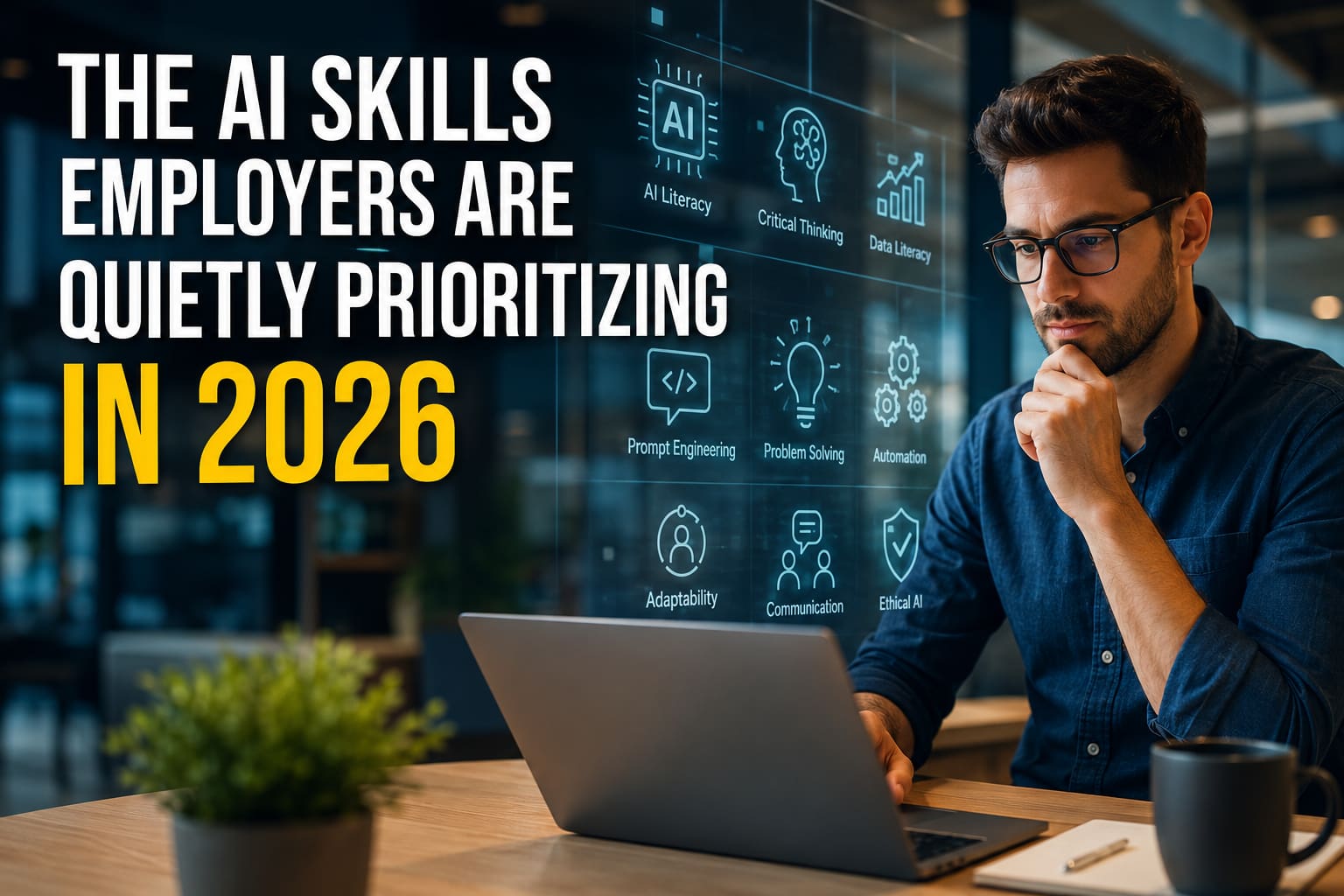
AI Literacy Is Becoming the New Digital Literacy
There was a time when basic computer skills were enough to stand out on a resume Later, familiarity with spreadsheets, cloud software and digital communication tools became standard expectations
Today, AI literacy is following a similar path
AI literacy doesn’t mean being a programmer or data scientist It means understanding what AI can do, where it can help and where human judgment is still required
Employers want workers who understand the strengths and limitations of AI systems They appreciate employees who know how to use AI as a productivity partner rather than viewing it as a magical solution for every problem
For example, a project manager who understands how AI can assist with planning, scheduling and reporting often works more efficiently than someone who ignores these tools entirely
In many organizations, AI literacy is quickly becoming a baseline skill rather than a specialized advantage
The Ability to Ask Better Questions
One of the most underrated workplace skills in 2026 is the ability to ask intelligent questions
AI systems are only as useful as the instructions they receive Employees who can clearly define problems, provide context and ask precise questions often get far better results
Think about it this way If you ask a colleague a vague question, you’re likely to receive a vague answer The same principle applies when working with AI
Employers are increasingly noticing workers who can:
- Break down complex challenges
- Define objectives clearly
- Request specific information
- Refine outputs through iteration
This ability goes far beyond technology It reflects critical thinking, communication and problem-solving skills that remain highly valuable in any workplace
Critical Thinking Matters More Than Ever
Many people assume AI reduces the need for human thinking In reality, the opposite is happening
As AI-generated information becomes more common, employers are placing greater value on people who can evaluate and verify information
AI can occasionally produce inaccurate, outdated or misleading results Businesses cannot afford to make important decisions based on unchecked information
That’s why critical thinking has become one of the most important AI-era skills
Professionals who can review AI-generated recommendations and identify potential flaws provide tremendous value to organizations
For example, a marketing team might receive AI-generated campaign ideas However, experienced marketers still need to determine which suggestions align with audience behavior, brand identity and business goals
AI can assist with decision-making but humans remain responsible for making the final call
Data Literacy Is No Longer Optional
Modern businesses generate enormous amounts of data
Sales figures, customer behavior metrics, website traffic reports, productivity analytics and financial forecasts all contribute to decision-making
AI tools make it easier to process data but employees still need to understand what the information actually means
Data literacy involves:
- Understanding key metrics
- Interpreting reports
- Recognizing trends
- Drawing meaningful conclusions
A professional who can confidently explain why a trend is happening often becomes more valuable than someone who simply presents numbers
Organizations increasingly want employees who can transform information into action
According to insights shared by organizations like the World Economic Forum, analytical thinking continues to rank among the most important workplace skills for the future economy
AI-Assisted Problem Solving
Employers are placing greater emphasis on practical problem-solving abilities
The question is no longer whether employees can use AI The real question is whether they can use it to solve real business challenges
Consider a customer support team experiencing longer response times An employee with AI-assisted problem-solving skills might identify repetitive inquiries, automate routine responses and free human agents to focus on complex cases
The value isn’t in using AI itself
The value comes from identifying opportunities where AI can improve outcomes
This mindset is becoming increasingly attractive to employers because it directly impacts productivity and efficiency
Adaptability Is Becoming a Competitive Advantage
One reason AI is reshaping the workplace so rapidly is the speed of innovation
New tools appear constantly Features change Workflows evolve
Skills that are highly valuable today may look different in a few years
As a result, employers are paying close attention to adaptability
They’re looking for individuals who:
- Learn quickly
- Stay curious
- Embrace change
- Continuously improve their skills
In many hiring decisions, a candidate’s willingness to learn may be just as important as their current knowledge
Companies understand that future success depends on employees who can grow alongside technology
Communication Remains a Powerful Human Skill
Despite all the excitement surrounding AI, communication remains one of the most valuable skills in any organization
AI can summarize information, draft content and organize data However, it cannot fully replace authentic human interaction
Strong communicators help teams collaborate effectively, resolve conflicts, explain complex ideas and build trust
Imagine a workplace where AI generates reports and recommendations Someone still needs to present those findings to stakeholders, answer questions and guide strategic discussions
That’s where communication skills become essential
Professionals who combine AI knowledge with excellent communication often stand out as future leaders
Understanding Ethical AI Use
As AI becomes more powerful, ethical concerns are becoming increasingly important
Businesses must think carefully about:
- Privacy
- Transparency
- Bias
- Data security
- Responsible automation
Employees who understand these challenges can help organizations avoid costly mistakes
Resources from the OECD AI Principles continue to emphasize responsible and trustworthy AI adoption
Employers appreciate professionals who understand that technology should be used responsibly and ethically
Why Human Skills Are Becoming More Valuable
One surprising trend is that the rise of AI is increasing demand for certain human skills
Creativity, emotional intelligence, leadership, collaboration and strategic thinking are becoming even more important
The reason is simple
AI excels at processing information but humans excel at understanding context, building relationships and making nuanced decisions
The future workplace will likely belong to people who can combine technical awareness with uniquely human strengths
Rather than competing against AI, successful professionals will learn how to work alongside it
Preparing for the Future Workplace
The good news is that developing these skills doesn’t require a complete career change
Small steps can make a significant difference:
- Learn basic AI concepts
- Improve your data literacy
- Practice critical thinking
- Stay informed about workplace technology trends
- Look for opportunities to automate repetitive tasks
- Continue strengthening communication and leadership abilities
The professionals who start adapting today will likely be in a stronger position tomorrow
FAQ
Do I need programming skills to benefit from AI?
No Most employers are looking for practical AI users who can improve productivity and solve problems, not necessarily software developers
Which AI skill is most important in 2026?
Critical thinking and AI-assisted problem-solving are among the most valuable because they combine technology with human judgment
Will AI replace most jobs?
AI is more likely to transform jobs than eliminate them completely Many roles will evolve to include AI-powered workflows
Why is data literacy becoming important?
Businesses increasingly rely on data-driven decisions Employees who can understand and interpret information provide greater value
How can I start improving my AI skills?
Begin by learning AI fundamentals, exploring practical use cases, improving analytical thinking and staying updated on industry developments
Conclusion
The conversation around artificial intelligence often focuses on automation, productivity and technological breakthroughs However, the most important workplace trend may be something far simpler
Employers are not just looking for people who understand AI They are looking for people who know how to think, adapt, communicate and solve problems in an AI-powered world
The professionals who thrive in 2026 won’t necessarily be those with the most technical knowledge Instead, they’ll be the ones who can combine human intelligence with AI capabilities to create better outcomes
As workplaces continue to evolve, developing these skills today could become one of the smartest career investments you make
About the Author