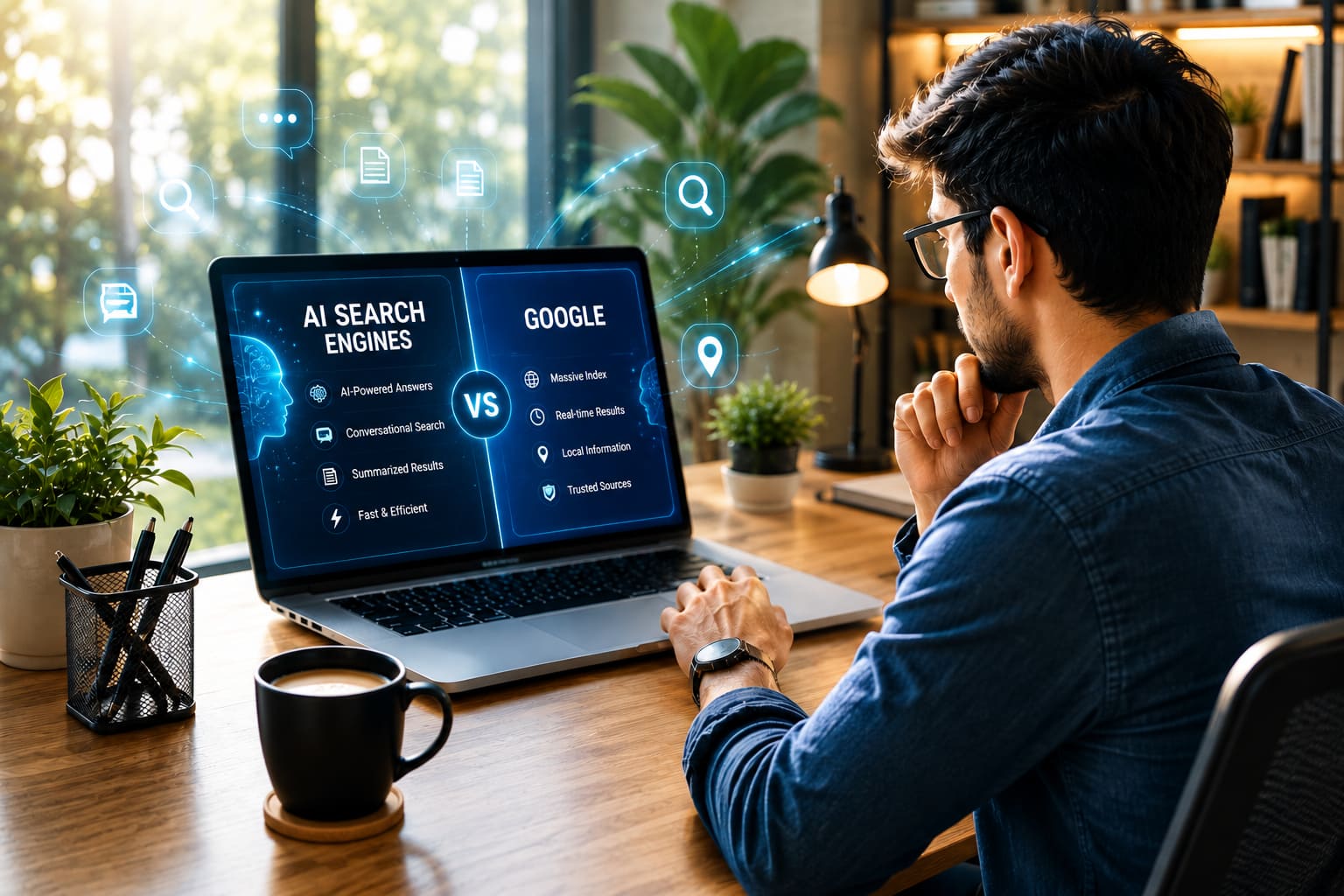
AI-powered search engines are changing how people find information by providing direct answers, while traditional search engines continue to offer access to a vast range of sources and real-time information.
For more than two decades, Google has been the dominant gateway to information on the internet.
Whether people wanted to find a recipe, research a topic, compare products, or solve a technical problem, Google was usually the first place they turned. But in 2026, the search landscape is changing faster than ever.
AI-powered search engines are attracting millions of users by offering direct answers instead of long lists of links. Rather than forcing users to open multiple websites and piece information together themselves, these tools aim to provide clear, conversational responses within seconds.
This shift has sparked an important question:
Are AI search engines actually better than Google?
The answer depends on how you use search and what kind of information you’re looking for.
What Is an AI Search Engine?
An AI search engine combines traditional web search with artificial intelligence.
Instead of simply displaying links, it attempts to:
- Understand your question
- Search relevant sources
- Summarize information
- Generate direct answers
- Provide conversational responses
Many AI-powered search tools can also handle follow-up questions without requiring users to start a new search.
Why AI Search Is Becoming Popular
People increasingly want answers, not just links.
Traditional search often requires:
- Opening multiple websites
- Comparing information
- Filtering irrelevant content
- Reading lengthy articles
AI search engines try to reduce this process by providing a summarized response immediately.
For many users, this creates a faster and more convenient experience.
Where Google Still Dominates
Despite the rise of AI search, Google remains incredibly powerful.
Google continues to excel in several important areas.
Massive Index of Information
Google has spent decades building one of the largest web indexes in history.
This allows it to find:
- News articles
- Research papers
- Videos
- Images
- Local businesses
- Shopping results
The depth of information remains difficult to match.
Local Search Results
When users search for:
- Restaurants
- Hotels
- Stores
- Directions
- Local services
Google still provides one of the most complete experiences available.
Its integration with maps and local business data remains a major advantage.
Real-Time Information
Breaking news and rapidly changing events often appear on Google quickly.
For highly time-sensitive searches, Google still has a strong advantage.
Where AI Search Engines Perform Better
AI search tools are excelling in situations where users need explanations rather than simple links.
Faster Research
Instead of opening multiple websites, users can often receive a useful summary immediately.
This saves time when researching:
- Technology
- Business
- Education
- Productivity
- General knowledge topics
Better Follow-Up Questions
Traditional search requires multiple separate searches.
AI search allows natural conversations.
For example:
- What is quantum computing?
- How does it work?
- What companies are investing in it?
These questions can be asked naturally without restarting the search process.
Easier Learning Experience
Many users find AI-generated explanations easier to understand than technical articles.
This makes AI search particularly attractive for:
- Students
- Beginners
- Casual learners
Accuracy: Who Wins?
This is where things become complicated.
Google primarily shows sources and lets users evaluate them.
AI search engines generate answers based on information they find.
While AI responses are often helpful, they can occasionally:
- Misinterpret information
- Oversimplify topics
- Present incorrect details confidently
Because of this, important decisions should still be verified using reliable sources.
For critical information, cross-checking remains essential.
Which Is Better for Students?
Students benefit from both approaches.
Google helps locate:
- Academic papers
- Official documents
- Research sources
AI search helps:
- Explain concepts
- Summarize information
- Simplify difficult topics
Many students now use both tools together.
Which Is Better for Professionals?
Professionals often prefer whichever option saves time.
AI search is useful for:
- Quick research
- Summaries
- Brainstorming
Google remains useful for:
- Verifying information
- Finding official sources
- Accessing specialized content
The most productive workflow often combines both.
The Future of Search
The competition between traditional search and AI-powered search is only beginning.
Future search experiences will likely include:
- More conversational interactions
- Better personalization
- Faster answers
- Improved source transparency
- Deeper integration of AI features
Rather than replacing Google completely, AI search may become another tool people use alongside traditional search engines.
Should You Stop Using Google?
Probably not.
Google remains one of the most powerful information tools ever created.
However, AI search engines offer significant advantages for learning, productivity, and research.
The smartest approach is not choosing one over the other.
It’s understanding when each tool works best.
FAQ
Are AI search engines replacing Google?
Not completely. They are becoming popular alternatives, but Google remains a major search platform.
Are AI search results always accurate?
No. AI-generated answers can sometimes contain mistakes and should be verified when accuracy is important.
Why do people like AI search?
Many users prefer direct answers instead of reviewing multiple websites.
Is Google still better for local searches?
Yes. Google continues to dominate local business, maps, and location-based searches.
What is the future of search?
Experts expect search to become more conversational, personalized, and AI-driven over the coming years.
Conclusion
The debate between AI search engines and Google isn’t really about replacing one with the other.
Both tools serve different purposes.
Google remains unmatched for discovering sources, local information, and real-time content. Meanwhile, AI search engines are changing how people learn by providing faster explanations, summaries, and conversational answers.
In 2026, the most effective strategy is using both.
Google helps you find information.
AI helps you understand it.
About the Author