Introduction
For decades, quantum computing was considered a technology of the distant future. It existed mostly in research laboratories, academic papers, and science fiction discussions. Most people believed practical quantum computers were still many years away.
However, recent developments suggest that the future may arrive sooner than expected.
Major technology companies, research institutions, and governments around the world are investing billions of dollars into quantum computing. Scientists continue making breakthroughs that bring this powerful technology closer to real-world applications.
While traditional computers have transformed modern life, quantum computers could potentially solve certain problems that would take today’s most powerful supercomputers thousands of years to complete.
The simple answer is this:
Quantum computing has the potential to revolutionize industries including healthcare, cybersecurity, artificial intelligence, finance, and scientific research, making it one of the most important technological developments of the coming decade.
Let’s explore what quantum computing is, how it works, and why experts believe it could change technology much sooner than many people expect.
What Is Quantum Computing?
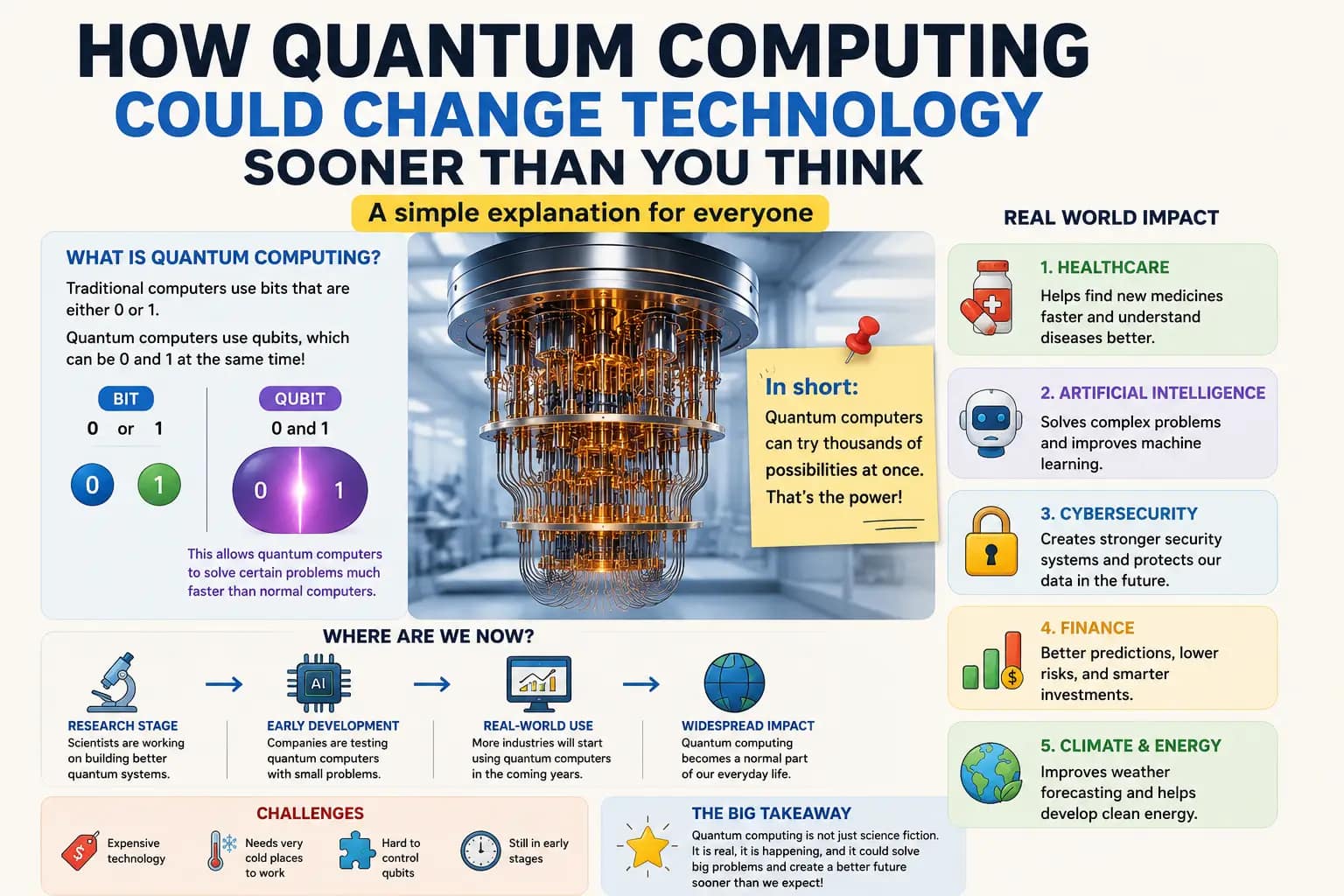
Traditional computers process information using bits.
A bit can exist in one of two states:
- 0
- 1
Every website, application, video, and digital service ultimately relies on these binary calculations.
Quantum computers work differently.
Instead of bits, they use qubits.
Qubits can exist in multiple states simultaneously through a principle known as quantum superposition.
This allows quantum computers to perform certain calculations far more efficiently than traditional systems.
Why Quantum Computing Matters
The world is generating more data than ever before.
At the same time, scientists and businesses face increasingly complex challenges.
Examples include:
- Drug discovery
- Climate modeling
- Financial forecasting
- Artificial intelligence
- Logistics optimization
Many of these problems push traditional computing systems to their limits.
Quantum computing offers a potential solution.
How Quantum Computers Differ From Traditional Computers
Traditional Computing
Traditional computers process information step by step.
They are incredibly effective for everyday tasks such as:
- Browsing websites
- Running applications
- Gaming
- Video editing
Quantum Computing
Quantum computers excel at solving specific types of complex problems.
Their unique architecture allows them to evaluate many possibilities simultaneously.
This capability could dramatically reduce computation times for certain tasks.
Industries That Could Be Transformed
Healthcare and Medicine
Drug development often requires years of research and testing.
Quantum computing could help researchers:
- Analyze molecular structures
- Simulate chemical reactions
- Discover new medicines faster
This could potentially reduce development costs and accelerate medical breakthroughs.
Artificial Intelligence
AI systems require enormous amounts of data processing.
Quantum computing could improve:
- Machine learning models
- Pattern recognition
- Data analysis
- Optimization tasks
As AI becomes more important, quantum technology may help unlock new capabilities.
Cybersecurity
Quantum computing presents both opportunities and challenges for cybersecurity.
Future quantum systems could potentially break certain encryption methods currently used across the internet.
At the same time, researchers are developing quantum-resistant security technologies to protect data.
Cybersecurity experts are already preparing for this transition.
Financial Services
Banks and financial institutions constantly analyze large amounts of information.
Quantum computing could help improve:
- Risk assessment
- Portfolio management
- Fraud detection
- Market predictions
Faster analysis could support better decision-making.
Climate and Environmental Research
Understanding climate systems requires massive computational power.
Quantum computers may help scientists:
- Improve weather forecasting
- Model environmental changes
- Optimize renewable energy systems
These advancements could support global sustainability efforts.
Why Technology Companies Are Investing Heavily
Leading technology companies understand the long-term potential of quantum computing.
Billions of dollars are being invested into:
- Quantum hardware
- Quantum software
- Research facilities
- Scientific partnerships
The race to achieve practical quantum computing is becoming one of the most significant technology competitions in history.
Companies that succeed may gain enormous advantages in innovation and research.
Challenges Still Facing Quantum Computing
Despite the excitement, significant obstacles remain.
Hardware Complexity
Quantum systems are extremely sensitive.
Even minor environmental interference can affect calculations.
Cost
Building and maintaining quantum computers remains expensive.
Advanced equipment and specialized facilities are often required.
Error Correction
Quantum calculations can be prone to errors.
Researchers continue developing more reliable systems.
Limited Practical Applications Today
Although progress is impressive, many real-world uses remain in development.
Widespread adoption will take time.
Could Quantum Computers Replace Traditional Computers?
Probably not.
Most people will continue using traditional computers, smartphones, and tablets for everyday tasks.
Quantum computers are likely to complement traditional systems rather than replace them.
Think of them as specialized tools designed for extremely complex computational challenges.
For everyday activities such as:
- Social media
- Web browsing
- Office work
Traditional computers remain highly effective.
What the Future May Look Like
Experts expect quantum computing to become increasingly important over the next decade.
Potential future developments include:
- Faster scientific discoveries
- Improved AI systems
- More efficient logistics networks
- Advanced cybersecurity solutions
- Breakthrough medical research
While widespread adoption may still take years, progress is accelerating rapidly.
The technology is moving from theoretical discussions toward practical implementation.
Practical Takeaways for Businesses and Individuals
You don’t need to become a quantum physicist to benefit from understanding this trend.
Instead:
Stay Informed
Technology is evolving quickly.
Watch Industry Developments
Major breakthroughs may influence many industries.
Learn Emerging Skills
Understanding future technologies can create career opportunities.
Follow AI and Quantum News
These fields are increasingly interconnected.
People who understand technological change often adapt more successfully.
FAQ
1. What is quantum computing?
Quantum computing is an advanced form of computing that uses qubits to perform calculations differently from traditional computers.
2. Why is quantum computing important?
It has the potential to solve complex problems much faster than current computers in certain situations.
3. Will quantum computers replace laptops?
No. Traditional computers will continue handling everyday tasks.
4. Which industries could benefit most?
Healthcare, finance, AI, cybersecurity, logistics, and scientific research are among the leading sectors.
5. Is quantum computing already being used?
Yes, research organizations and technology companies are actively testing and developing quantum systems, though widespread adoption remains limited.
Conclusion
Quantum computing is no longer just a futuristic concept. It is rapidly becoming one of the most exciting areas of technological innovation.
Although significant challenges remain, ongoing breakthroughs suggest that practical applications may arrive sooner than many people expect.
From healthcare and artificial intelligence to cybersecurity and climate research, the potential impact of quantum computing is enormous.
While most consumers may never directly use a quantum computer, the innovations it enables could influence countless technologies and services in the years ahead.
Related Resources
About the Author